 F4LUFTBILDER
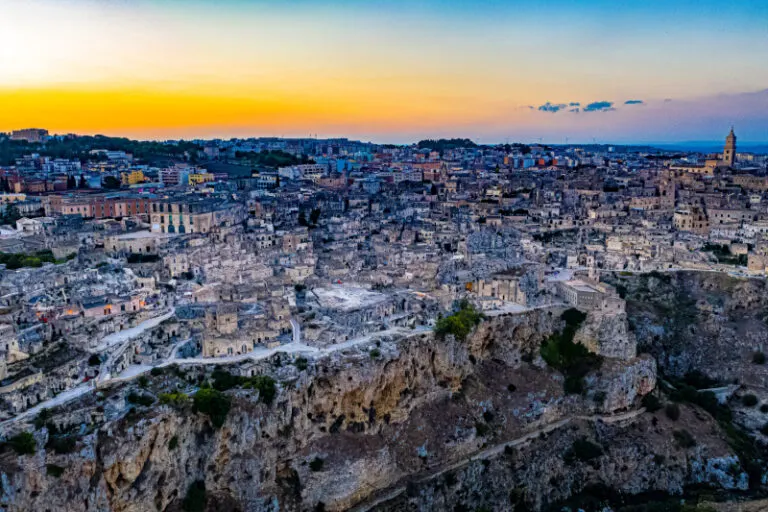


Matera and the flanks of the gorge
At Matera, the deep gorge directly approaches the densely built-up city. The bright building areas and the surrounding rock are close in color to each other. From an oblique perspective, elevation and shadows become important in distinguishing roofs, paths and natural rock pieces.
The town on the edge of Gravina
In Matera, rock shapes and buildings intertwine. If you first look for the opposite side of the gorge, you can then more easily follow the direction of the terraced buildings.
Rock surfaces are often harder to read in an aerial photograph than their sharp outline suggests. A dark area can be a deep crevice or just in shadow. The connection of several visible edges provides information. Where they converge and cover a surface, a spatial jump is understandable. A location with clear rock contours is suitable for publication with smaller images. In a larger format, the eye can wander more over the finer differences in the surface.
What the roofs reveal about the floor plan
If you look at it at an angle, the houses not only show their roofs, but also their facades of different widths. This gives the motif more depth than in the pure top view. Even the change from a low neighboring building to a taller building reveals something about the gradation of the place. Such a view is particularly useful for a local chronicle if the caption indicates the starting point of the view. Readers can then follow the rows of houses themselves to the edge of the picture.
Recognize the shape of the valley area
Two different narrative directions emerge along a valley and across it. The longitudinal view leads into the distance and shows what is arranged one behind the other. Looking sideways, the width of the valley floor and the rise on either side become clearer. Which view is convincing depends on the question asked of the image. For a description of the location, a lateral view is often productive. For a stretch along a route, the longitudinal view gives the viewer a direction to follow across multiple subjects.
Warm tones within the series
Among the 16 photos in the gallery, shot 3 and shot 14 provide a good starting point for the comparison. In the second view, warm reds and browns have more weight than in the first. Red-brown and yellowish areas are particularly noticeable next to cooler surfaces. What is interesting when comparing is whether they are concentrated on a single object or appear spread out across the entire view.
The camera captured October 21, 2019 for shot 1 and shot 16. The time interval between these two views is approximately 162 minutes. The exposure time was 1/60 second for the first of the images mentioned and 1/10 second for the second.
A moving view is also available. The clip “Matera” can be found under Aerial Videos. The linked preview leads to inclusion in the aerial photographer's portfolio on Adobe Stock.
Show the proportions of the landscape
It is easy to overestimate the size of a shape in a landscape painting. A bright spot may be a small open area or show an extensive portion of the terrain. When selecting images, a comprehensible reference point is therefore more important than the most dramatic perspective possible. If present in the motif, a path or a clearly recognizable shoreline can take on this task. An aerial photographer can also relate an overview and a single view. Readers are then given an idea of the location before viewing the surface up close.
More aerial photos for comparison
Two further articles invite comparison. In the first, Italy – Corniglia, a different detail is in the foreground. Corniglia sits high above the sea on a protruding stretch of the Ligurian coast. Then Greece – Athens is a good option. The rock of the Acropolis interrupts the densely built-up urban area of Athens.
Aerial photos of Matera
Your aerial photographer across Europe
Request a free quote