 F4LUFTBILDER
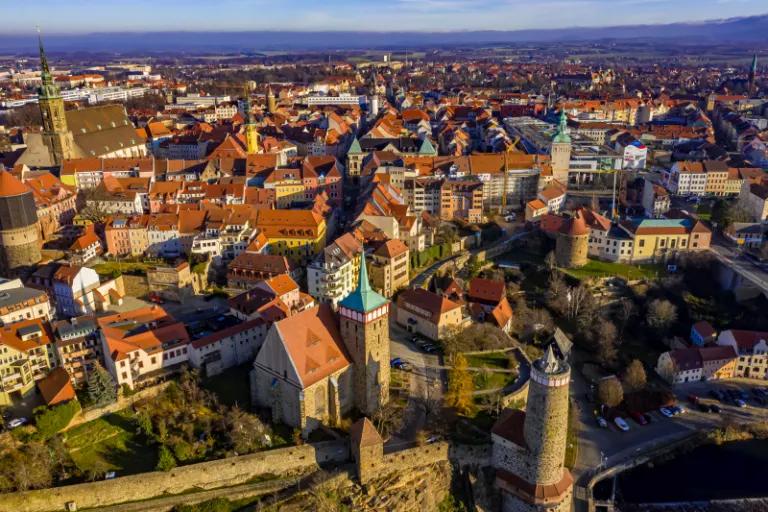


Bautzen's towers above the valley
In Bautzen, towers, roofs and larger assemblies are staggered above the lower terrain. A side view makes this height sequence clear. When viewed from above, the narrow streets gain in weight and reveal the close proximity of the historic buildings.
The staggered city silhouette
In Bautzen the eye finds its way back to the city skyline several times over the towers. A photo with a visible valley also makes it understandable why the buildings stand out so clearly above the foreground.
Up close, a tower draws the eye upwards. In the aerial photograph this movement is reversed. From the top, the eye follows the sides down to the ground and finds paths, neighboring buildings or vegetation for size comparison. A steep perspective shortens the visible shaft. When viewed from the side, it stands out from its surroundings. When selecting a representative image, it is therefore crucial whether the shape of the tower or its location in the terrain should be shown.
What the roofs reveal about the floor plan
If you look at it at an angle, the houses not only show their roofs, but also their facades of different widths. This gives the motif more depth than in the pure top view. Even the change from a low neighboring building to a taller building reveals something about the gradation of the place. Such a view is particularly useful for a local chronicle if the caption indicates the starting point of the view. Readers can then follow the rows of houses themselves to the edge of the picture.
Recognize the shape of the valley area
The location in a valley is made clear in the aerial photo by the lateral boundaries. A nearby slope pushes forward in front of a distant one, and the valley floor opens up in between. If the section is too narrow, it can easily give the impression of a flat surface. A shot with a bit of a slope at the edge of the image preserves the context. Orientation is particularly successful when there is also a familiar size comparison, such as a street or a house. The eye can then better assess the depth between the individual landscape levels.
Warm tones within the series
If you browse through the 17 aerial photos, you can stay at shot 11 and shot 5 for a comparison. In the second view, warm reds and browns have more weight than in the first. Red-brown and yellowish areas are particularly noticeable next to cooler surfaces. What is interesting when comparing is whether they are concentrated on a single object or appear spread out across the entire view.
For Shot 17 and Shot 1, the same day is noted in the image files, December 18, 2020. The recording times recorded are about 4 minutes apart. The exposure time was 1/320 second for the first of the images mentioned and 1/400 second for the second.
A moving view is also available. The clip “Bautzen from the air” can be found under Aerial videos. The linked preview leads to inclusion in the aerial photographer's portfolio on Adobe Stock.
Communicate architecture and location together
Anyone who has visited a building themselves often remembers the entrance and the first view upwards. In the aerial photograph, these exact areas can disappear behind a roof or a wall. A suitable caption helps to connect the tour experienced with the spatial overview. For an aerial photographer, planned use is therefore a good starting point. A view for a site plan needs clear outer edges. An image for the cover page may focus more on the interaction between the building and its surroundings.
Related motifs in the aerial photo archive
If you are looking for related motifs, you can start with Löbau. In Löbau, dense red roof areas alternate with more open built-up areas in which large buildings take up significantly more space. It's worth taking a second look at Görlitz. In the Görlitz series, wisps of fog rise between roofs and towers.
Aerial photos of Bautzen
Aerial photography & aerial videos
Your aerial photographer for Bautzen and the surrounding area
F4 Luftbilder – Your specialist for aerial photographs and aerial photography in Bautzen and the surrounding area. Benefit from our many years of experience and technical equipment and let us convince you of quick implementation and unbureaucratic processing. We look forward to inspiring you with breathtaking aerial photographs and aerial photos in Bautzen and the surrounding area.
Services
Aerial photos in 4K resolution
Aerial videos in 4K resolution
Individual perspective wishes
Including image editing
All necessary permits and insurance
Free travel to Bautzen and the surrounding area
Your advantages
Direct contact person
No appointment required
Unbureaucratic & short-term processing
Pay conveniently by invoice: bank transfer & Paypal
Delivery of images conveniently via download
Order processing within 10 days
Request a quoteBautzen from the air – breathtaking photos of a unique city
Bautzen – a unique city
Bautzen is a beautiful city that looks even more impressive when viewed from the air. The breathtaking images taken by a drone show the unique beauty of this city. The city of Bautzen is located in the east of Germany, in Saxon Upper Lusatia. It is the district town and also the largest city in the Bautzen district. The city has a long history and was first mentioned in documents in the 11th century. Bautzen is known for its medieval core, which is surrounded by an impressive fortress. Bautzen Fortress is one of the city's landmarks and also a popular tourist destination. From the fortress you have a wonderful view of the entire city. The historic old town of Bautzen is also worth seeing and offers many sights, such as the town hall or St. Mary's Church. The old town of Bautzen is also known for its many alleys and churches. It was declared a UNESCO World Heritage Site in 2002. Overall, Bautzen is a city worth seeing with many interesting sights. The breathtaking aerial shots allow you to view and enjoy the beauty of this city even better.
Bautzen from the air – breathtaking shots
Bautzen is a beautiful city that is best known for its architecture. The city has a long history and is home to many different cultures. This is also reflected in the architecture. In recent years, more and more people have shown interest in the city, making it a popular travel destination. Thanks to the new photos of Bautzen from the air, we can now see the beauty of the city from a whole new perspective.
The history of Bautzen
Bautzen is a city with a remarkable history. The region around Bautzen was already an important trade route in Roman times and the town itself was an important fortress. In the Middle Ages, Bautzen was one of the most important cities of the Holy Roman Empire and was one of the residences of the German king. To this day, Bautzen is one of the most important cities in Saxony and has developed into a popular tourist destination. The impressive historical buildings, the picturesque old town and the breathtaking views of the surrounding area make Bautzen a unique place.
Culture and sights in Bautzen
Bautzen is known for its historical sights and buildings. The city is full of old houses and buildings that attract visitors from all over the world. The old town of Bautzen is home to a variety of churches, each with their own charm and flair. St. Peter's Cathedral is the city's main church and one of Bautzen's most famous landmarks. Other famous churches in Bautzen are St. John's Church, St. George's Church and St. Pankratius Church. For art lovers, a visit to the Bautzen Museum is a must. The museum houses an impressive collection of paintings, sculptures and other works of art from the region. Another highlight in Bautzen is the Gewandhaus, a magnificent baroque building that was originally built as a merchant's house. Today concerts and other cultural events take place in the building. Anyone interested in the history of Bautzen should also take a detour to the Historical Museum of Upper Lusatia. Here you can find out everything about the eventful past of the city and its residents. Another interesting museum in Bautzen is the Natural History Museum, which has an extensive collection of minerals, fossils and animal specimens.